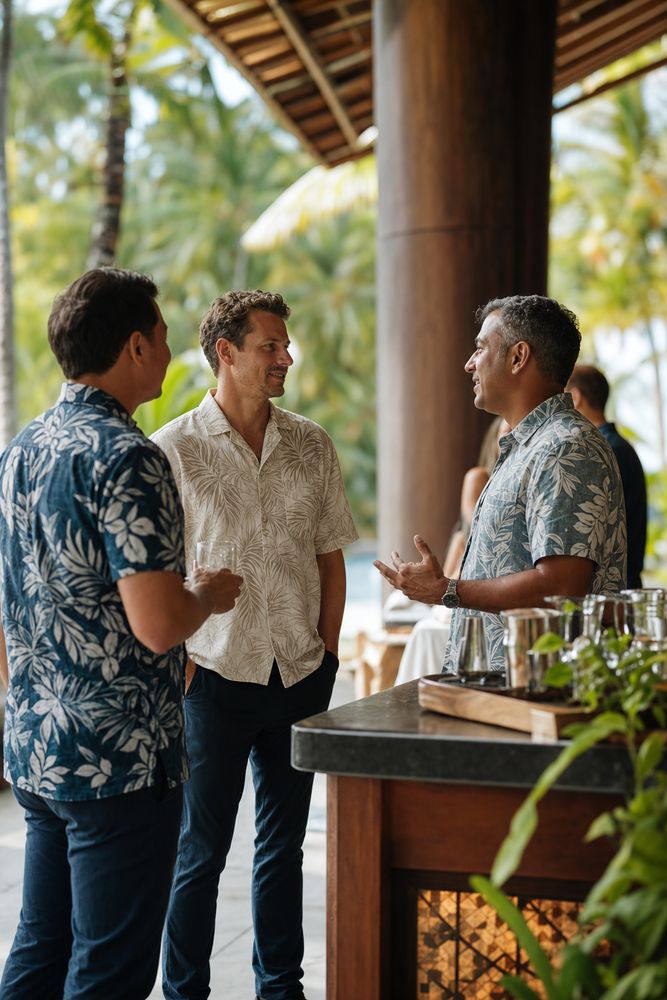
A corporate event in Hawaii is planned across an ocean. The decision makers usually sit in a mainland office, the venue is on an island most of them have not walked, and the guests are flying five to ten hours to attend. None of that is a problem, but it changes the order in which decisions should be made and how much lead time each one deserves. This guide walks the full arc for a corporate buyer: setting the goal, structuring the budget, choosing the island, holding the timeline, coordinating vendors, planning for weather, and treating the place with respect. It is the how-it-works companion to our corporate events page, which covers the formats we design and how an engagement begins.
What Should You Decide Before Anything Else?
The business purpose of the event, stated in one sentence, before any venue is toured or any date is floated. Everything downstream, from the island you choose to the shape of the evenings, follows from whether the gathering is meant to align a leadership team, reward top performers, convene a larger audience, or strengthen how a team works together. Groups that skip this step tend to buy a beautiful week that does not do any particular job.
The purpose usually resolves into one of a few familiar shapes, and each pulls the plan in a different direction. A leadership retreat wants seclusion, unhurried meals, and generous white space in the agenda. An incentive trip is a reward, so the accommodation and the signature experiences carry more of the budget than the meeting room does. A conference or company meeting is infrastructure-first: session space, AV, and the flow of people between rooms decide the venue before the view does. And team building lives or dies on the quality of the activity partners rather than the setting alone. Name the shape early and half of your later decisions make themselves.
How Should the Budget Be Structured?
As ranked categories with deliberate tradeoffs, not as a single number to be divided up later. For a Hawaii corporate event, the major categories are venue and food and beverage, accommodation, transportation and logistics, programming and entertainment, production (sound, lighting, staging, rentals), and a contingency reserve. Agreeing on the ranking among them at the start is what prevents the quiet creep that otherwise happens one vendor decision at a time.
Two categories deserve more respect than mainland instinct gives them. Transportation is the one buyers most often underestimate: moving a group between an airport, a hotel, and an off-site venue on island roads takes charter planning, not a stack of rental cars. Production is the other, because rental inventory on an island is finite; what is not available locally has to be shipped, and shipping has lead times that a late decision cannot buy back.
The tradeoff principle we hold to is simple: fund the two or three moments guests will still be describing a month later, and economize without apology on the things no one remembers. A remarkable open-air dinner matters more than upgraded linens everywhere. And keep the contingency reserve genuinely untouched until event week; a reserve that got spent in month two is a line item, not a reserve.
Which Island Fits Which Kind of Event?
There is no single best island, only a best match between an island’s character and your group’s purpose, size, and logistics. Oʻahu offers the most flight options, hotel inventory, and vendor depth, which makes it the practical default for larger groups and tighter timelines. Maui and the resort coasts of Hawaiʻi Island suit incentive-style programs built around a self-contained resort. Kauaʻi trades infrastructure for drama and rewards smaller, senior groups that value seclusion.
Oʻahu’s quieter advantage is variety within a short drive: a group can hold sessions near Honolulu, dine at a private estate, and spend a day at a working ranch without changing hotels. Maui concentrates its strengths along resort corridors where everything a program needs sits within a few miles. Hawaiʻi Island offers expansive resort grounds and the most varied landscape of the chain, useful when the program wants a sense of scale. Kauaʻi has fewer large venues, which is precisely its appeal for the right group.
Within any island, the venue types repeat: resort lawns and ballrooms, private estates, working ranches, botanical gardens, and open-air pavilions. Each carries different rules about noise, hours, vendors, and weather backup, and those rules shape the program more than the photographs do. Our venues page walks through the settings we plan around and what each one asks of an event.
Corporate Events
If you are mapping an event like this, our corporate events page covers formats, settings, and how a JJ Signature engagement begins.
Explore Corporate Events →
What Should Be Locked at Six, Three, and One Month Out?
As general practice: six months out, the venue, the date, and the room block; three months out, the program, the transportation plan, and every vendor contract; one month out, the final headcount, the run of show, and a written weather plan. Working backward from those checkpoints tells you when planning has to begin, and for most Hawaii corporate events that is earlier than the mainland equivalent, because sought-after venues and the best cultural and entertainment partners hold limited calendars.
Six months out is the structural stage. The venue contract is signed, the room block is held, travel guidance has gone to attendees, and the major vendors, catering, production, transportation, and any cultural practitioners, are reserved even if details remain open. If your date is fixed by a fiscal year or a board calendar, start earlier still; flexibility of date is the one lever a corporate group rarely has.
Three months out is the design stage. The agenda is final enough to schedule against, menus are chosen, AV specifications are confirmed, the transport plan covers every movement of the group from landing to departure, and contracts are signed rather than promised. One month out is the tightening stage: headcounts, dietary notes, seating, a run of show in minutes rather than hours, and the weather contingency written down and shared, not assumed. In the final week, everything gets reconfirmed with every vendor, ideally in one walkthrough on site with all of them present at once. A step skipped on this timeline does not disappear; it surfaces on the day, in front of the people the event was meant to impress.
How Does Vendor Coordination Work Across an Island?
Through one accountable coordinator and one shared timeline, because Hawaii’s vendor community is organized by island, not by state. A Maui florist does not serve an Oʻahu event, and each island’s pool of rentals, staffing, and production equipment is its own finite inventory. Coordination is therefore mostly a matter of booking the right people early and keeping every one of them working from the same document.
The mechanics are unglamorous and decisive. Anything not available on your island ships across water, so rentals and specialty items are ordered against barge and freight schedules, not against the event date. Vendors receive the same run of show, the same site map, and the same contact person, so the caterer, the production lead, and the venue manager are never operating on three different assumptions about the same hour. And the walkthrough happens with everyone in the same place at the same time, because the conflicts worth catching only reveal themselves when the lighting plan, the catering path, and the sunset are discussed together.
What Contingency Planning Does Hawaii Require?
A written weather plan for every outdoor element, arrival buffers that respect a long-haul flight, and a backup for any single point of failure, whether that is one shuttle, one generator, or one key speaker’s connection through a mainland hub. Hawaii’s weather is generally kind, but it is localized and it moves quickly, so good contingency planning is about speed of decision rather than fear of rain.
The dry season, roughly May through October, is when outdoor programming behaves most predictably; the winter months bring shorter, heavier showers that can move a dinner indoors on short notice. Neither season is wrong to choose. What matters is that the covered alternative is identified in the venue contract, that the decision deadline is agreed in advance (call the location by early afternoon, not at dusk), and that the backup is genuinely rehearsed rather than gestured at. For arrivals, build slack: key participants land a day ahead of anything they cannot miss, and departure transfers assume island traffic rather than hoping around it.
How Do You Plan With Cultural Respect in Hawaii?
By treating Hawaii as a host community rather than a backdrop. In practice, that means engaging local cultural practitioners on their own terms, using Hawaiian place names correctly in materials and on stage, and making sure any cultural element in the program carries context and consent instead of being staged as decor.
When a blessing, a lei greeting, or live Hawaiian music belongs in a program, the practitioner decides what they are willing to share and how it should be framed; the planner’s job is to build the hospitality and the schedule around that guidance, not the reverse. Brief your guests on where they are, favor local vendors and local food where the program allows, and leave every site as it was found. Done this way, the cultural thread of an event reads as a genuine introduction to the place, which is what most visiting teams are actually hoping for.
None of this is complicated when the decisions are made early, in the right order, by people with island relationships. That is the work JJ Signature Experiences exists to carry: the goal-setting conversation at the start, the calendar that holds, the vendors who answer, and the contingency nobody ends up noticing. If you are weighing an island, a season, or a format, we are glad to think it through with you.
Begin Your Journey